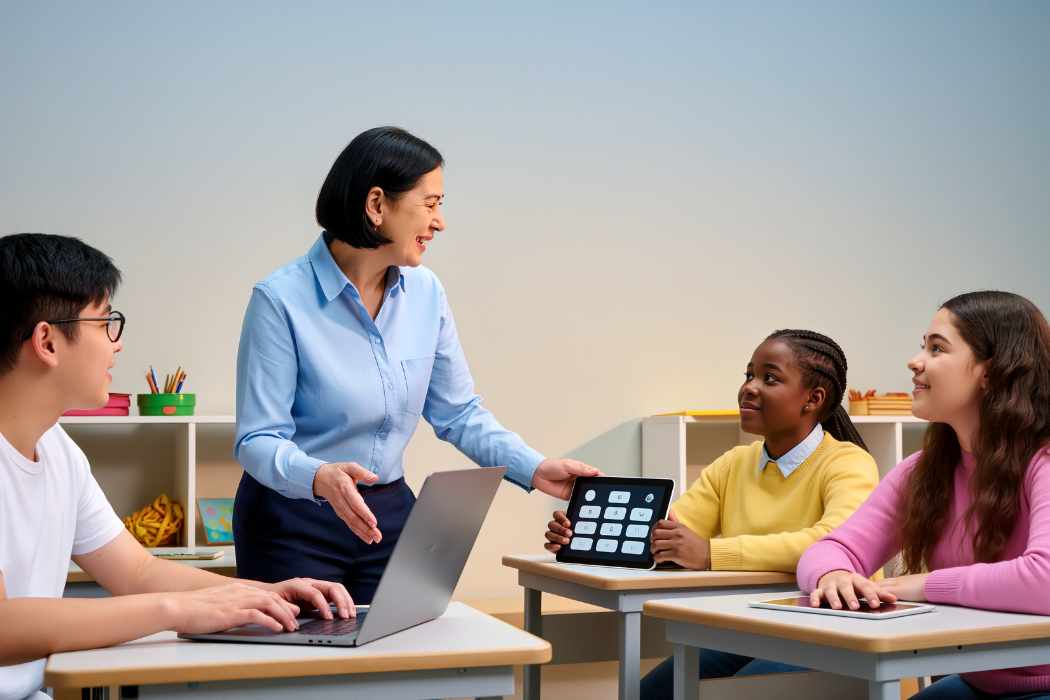
Teaching has changed quite substantially . This is due to the changing technologies, and what the future employment market may demand. Many schools, rather than having their students sit and just ‘listen’ to fact after fact being churned out are, instead, opting for more play-based and interactive learning methods.
Here, we want to look at the evolution of teaching methods in this area, and why they have changed.
Why Teaching Methods Have Evolved
Sure, school curriculums often don’t evolve as fast as they should, but they do evolve. Recent evolutions of school curriculums in the UK have focused heavily on more skills-based learning, helping students prepare for 21st-century careers.
As technology evolves, schools need to keep up. Students need to learn skills that will help them in the real world, including computing skills, teamwork, and more. Curriculums are working hard to include all of that, with a huge focus on practical skills, rather than forcing students to recite facts.
While curriculums still need to develop a little bit, students of today should be prepared for more modern 21st-century careers.
Play-Based Learning
The early part of a child’s learning will be play-based learning, with almost all of this happening during primary school.
With play-based learning, children don’t know they are being ‘taught’. They are just having fun, while also picking up useful skills.
Play-based learning focuses on exploration, creativity, and social development. You probably did a lot of this back in primary school. For example, making clay sculptures, playing in the sand pit, etc.
The key aim of play-based learning is to increase skills that will set a child up for their schooling life, and beyond. This includes learning communication, problem-solving, and boosting confidence.
Inquiry-Based Learning
As a child gets older, a lot more of their education becomes focused on inquiry-based learning. Here, children learn by asking questions and investigating. This involves a lot of science experiments and research projects. This will likely continue throughout the child’s schooling career. As the student gets older, teachers will encourage more and more independent learning here.
Inquiry-based learning focuses on improving critical thinking and boosting curiosity, something which is essential for thriving in the modern job market.
Project-Based Learning (PBL)
This is very much an evolution on inquiry-based learning. The major difference is that PBL is often more long-term, and focuses on real-world projects. For example, coding a small app or website, etc. Some schools may even have their students set up a small business, or something similar to that.
PBL will often involve team work, and may even involve aspects from different subjects, promoting cross-curricular learning.
Since modern careers will often involve projects, the skills picked up here are essential. Students will learn about teamwork, planning, and there will also be a healthy amount of independent learning too.
STEM & STEAM Education
Science, technology, engineering and maths (STEM), or adding in ‘arts’ (STEAM) have become a key part of school curriculums.
STEM matters for all modern careers, since the future will be very technology-focused. STEM also enhances problem-solving skills and boosts logical thinking. While many students hate maths and see no point to it (they think they will have a calculator everywhere they go), maths is, without a doubt, one of the most important subjects at school for this reason.
STEM learning is now equipping students for the modern world. Many schools are now focusing on robotics, coding, and solving engineering problems. Many jobs in the future, particularly the well paying ones, will require some of these skills. So, it is best to prepare students early. Even if a student doesn’t take a career in STEM/STEAM, many of the skills learned during these lessons will help them in the future.
Blended & Digital Learning
Most schools will now combine classroom teaching with online tools. This may mean using educational apps, videos, and virtual labs. It, essentially, enhances the teaching while also providing a student with a degree of independent learning.
This type of education is essential nowadays. In the past, schools focused purely on one learning style, which often left students behind. With digital tools, schools can adapt to many different learning styles, ensuring their students learn in the right way.
Many digital learning experiences also offer personalised pacing for students, ensuring that a student doesn’t ‘move on’ until they can fully grasp a concept.
Differentiated Instruction
Once again, schools of the past were very much focused on one learning style, and they had a fixed pace to keep. This meant many students, some of whom could be quite gifted in the right circumstances, were left behind.
School curriculums are now starting to understand the importance of catering to the individual. This means teaching has become more inclusive, and can now cater to multiple learning styles and abilities. Lessons can be paced based on the individual, whether they are SEND, EAL, or a gifted learner.
The hope is that more inclusive school curriculums will ensure that students will be far better prepared for the real world. It won’t just be the students that work best with a very specific style of teaching.
Collaborative & Social Learning
More and more schools are now focusing on much more collaborative learning, because this enhances skills for modern employment. Expect a lot more group work, peer-to-peer learning and discussions in class.
This will happen from an early age, and students will learn communication, empathy, and teamwork.
How Schools Can Adopt Modern Methods
As much as schools know they need to adapt their teaching techniques, it can be a slow process. Thankfully, there are a few ways that things can be made easier:
- Investment in professional development for teachers. Teacher training can go a long way toward encouraging modern teaching techniques.
- The encouragement to use digital tools effectively. Teachers need to research the right tools for their students, and incorporate them into learning. Although, teachers must also take great care to ensure that digital learning is not the only teaching method.
- Classrooms need to be flexible. This means more teaching styles, and the ability to adapt the way of teaching for unique student needs. Not everybody will move at the same pace.
- Schools should keep parents in the loop about teaching methods, and perhaps collaborate with them to devise more modern learning plans, including the use of digital tools.
Modern Teaching Methods 101
Modern teaching methods are vital for improving engagement in the classroom, while also developing skills that can be used in the real-world.
As with all forms of teaching, there is no ‘one size fits all’ approach, and teachers will need to use multiple methods to ensure the best education for their students.
The future of teaching should be adaptable, creative, and technology-enhanced. If this can happen, then graduating students will always be in the best position to succeed in the modern employment market.
Need a site designed by an experienced company? Contact School Jotter. We specialise in school website development and marketing, ensuring that you never need to worry about the issues we highlighted.