WordPress is one of the most widely used CMS platforms on the planet. So widely used, in fact, that is powers roughly 43% of all websites! Its free, flexible, open-source nature make it seem like an obvious choice for your school website — simply pick a theme and you’ll have a website by the end of the week. However, free plus speed doesn’t equal right for schools.
Educational establishments have requirements that are worlds apart from typical businesses. And whether general-purpose CMS platforms like WordPress have the capabilities to meet such intrinsic needs is the question we’re answering here.
Is WordPress Good for School Websites?
WordPress has the power to create professional and highly customised school websites with relative ease — all without spending a pound.
Adding to this power is the massive ecosystem of themes and plugins. From an entire school theme complete with a calendar, news section, and faculty directory to contact forms to photo galleries to LMS integrations, there’s a ready-made plugin for almost everything, helping you create a seamless site that students and parents will find easier to use.
Provided you have technical expertise available, you could consider WordPress to be your one-stop school website shop. However, all this flexibility and endless plugin options add to its complexity. The initial website build may be straightforward enough, but ongoing management (a crucial part in any school website) is another ball game.
Despite its brilliance for many businesses, WordPress isn’t the best choice for school websites for the following reasons:
1. WordPress Isn’t Specifically Designed for Schools
WordPress started life as blogging software, transitioning somewhere along the line to become a general-purpose CMS. At its core, it’s a posts and pages data model, meaning everything you need to make your site function as a school website, such as student portals, parent communications, curriculum information, calendars, grade viewers, payment integrations, and enrolment forms, must be bolted on using plugins and/or custom development.
Your WordPress-built “school website” is just a blog in school’s clothing. The moment you begin adding all the specifics required by school websites is the moment you begin fighting the platform.
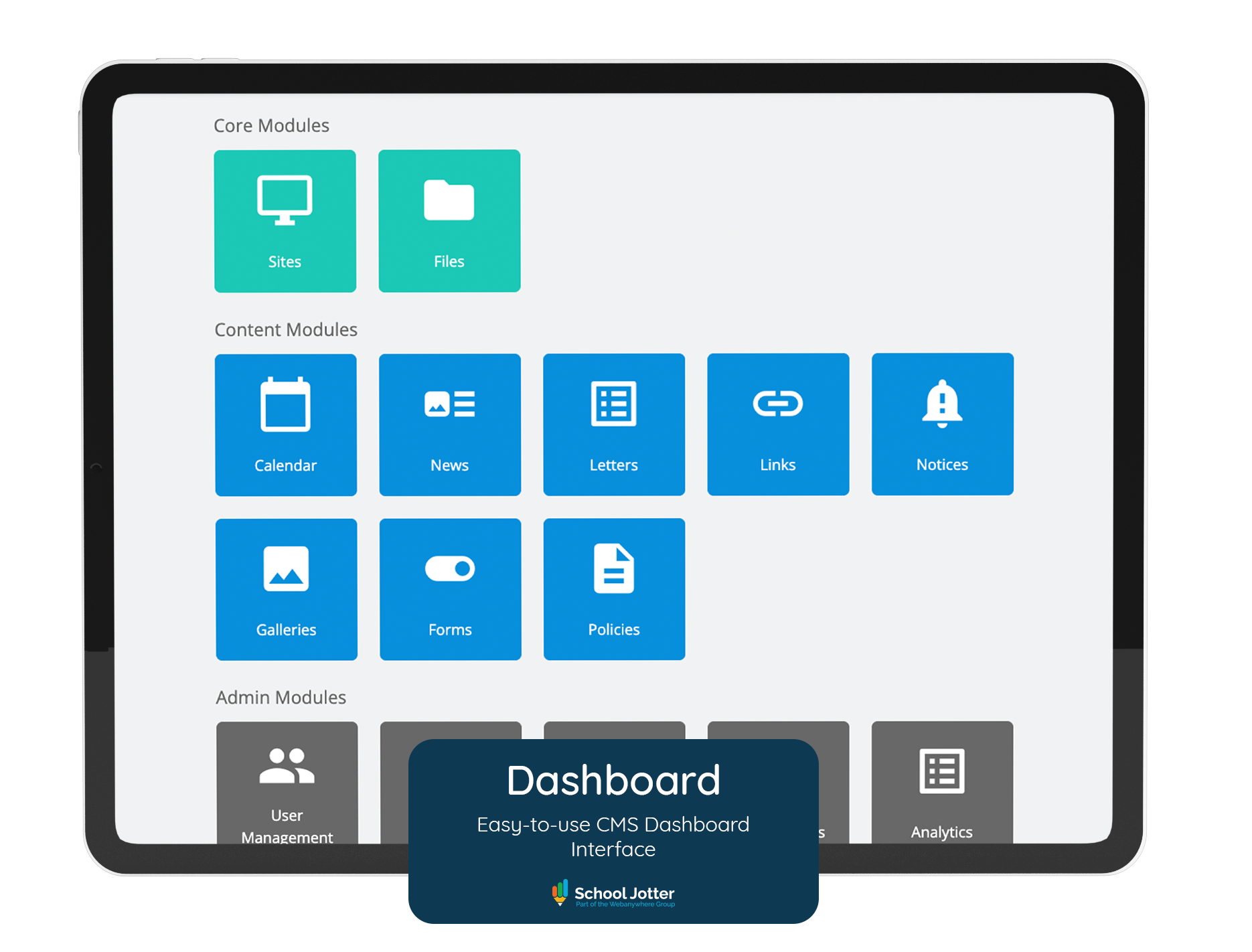
With a purpose-built school CMS, like School Jotter, however, all education-focused functionalities are included as standard, ensuring the platform works seamlessly from the get-go.
2. Website Management Can Become Complicated
Different WordPress themes and plugins make management complicated where it should be easy. Updates must be done separately for each addition and skipping for a few months can lead to disastrous consequences. In the same breath, blindly updating plugins can lead to breakdowns and unforeseen downtime.
Generally speaking, school websites are managed by staff members who aren’t developers, marketers, or have any tech experience. And when each plugin works differently, making quick, everyday changes becomes nightmarish.
With School Jotter’s school-specific CMS, you’re afforded drag-and-drop functionality, simple page organisation, and structured file storage to streamline web management processes, saving time and money.
3. WordPress Plugins Create Additional Dependencies
Beyond the core data model, WordPress’s functionality stems from third-party plugins. Said plugins are designed and maintained by a plethora of developers who can discontinue or change them as they wish. The latter can cause incompatibilities or complete breakdowns if left unattended.
While plugins are certainly useful, they bring additional management dependencies that your school likely doesn’t have the time or technical resources to oversee. As such, purpose-built school CMS platforms tend to be better suited — no third-party plugins to add extra management requirements.
4. Security Requires Ongoing Management
Security is important for all businesses, but especially for schools. Unfortunately, retaining such web security on WordPress can be difficult due to the various components — core, plugins, and themes — that require regular updates to patch vulnerabilities. Failing to update in a timely manner can cause security issues.
Schools should seek a one-stop platform has clear responsibilities for hosting, backups, updates, and monitoring, like School Jotter’s CMS. Our managed platform reduces your staff’s technical responsibility, allowing our professionals to do the back-end work.
5. Training Can Be More Difficult to Standardise
As mentioned, different WordPress websites have entirely distinct themes, page builders, and plugins. Frustratingly, moving between WordPress websites doesn’t mean the editing experience will be the same — it might be, but it’s likely there will be fundamental differences.
Why does this matter? Your staff may need regular retraining, and new hires may require additional training just to use all the features correctly. The problem of not-so-standardised training compounds for MATs with multiple websites.
With one, school-specific platform, however, you receive ongoing support and training (throughout the UK with us at School Jotter), ensuring the whole team is on the same page at all times.
6. Managing Multiple School Websites Can Be More Complex
Speaking of MATs and larger organisations, maintaining separate WordPress installations can create additional administration that costs time, resources, and money.
When numerous school websites are at play, branding, updates, and permissions consistency becomes vital. Unfortunately, these are hard to achieve with disparate WordPress iterations.
A central management hub makes life much easier for MAT teams, reducing admin spend and complexity. Through School Jotter’s MAT Dashboard, you can access all trust-led websites through a single platform.
7. School-Specific Features Can Reduce Admin
Specialist school-specific software isn’t just easier or better than WordPress; it’s a complete set of functionality features designed around typical school requirements. No adapted generic web plugins here.
Individual schools and MATs alike stand to gain a myriad of much-needed features from a purpose-built school CMS like School Jotter. Some such features include:
- Policy review alerts
- Ofsted detection alerts
- Calendar synchronisation
- Attendance features
- Enrolment forms
- Accessibility tools
- Push notifications
Everything you need for an optimal school website is at your fingertips.
WordPress VS a School-Specific CMS: Which Should You Choose?
WordPress offers incredible flexibility and customisation, thanks to its of high-powered themes and plugins. For general purposes, its free, open-source nature is a no-brainer. However, for schools and their specific requirements, it can cause more problems than it solves.
You need a platform that won’t put up a fight when asking it to fit your needs. And that’s precisely what our purpose-built-for-schools CMS at School Jotter provides. Packed with essential features and a central management hub, it’s a one-stop-shop for all your individual school or MAT website needs.