5 Benefits Of A School Website Audit

Published: April 20, 2026

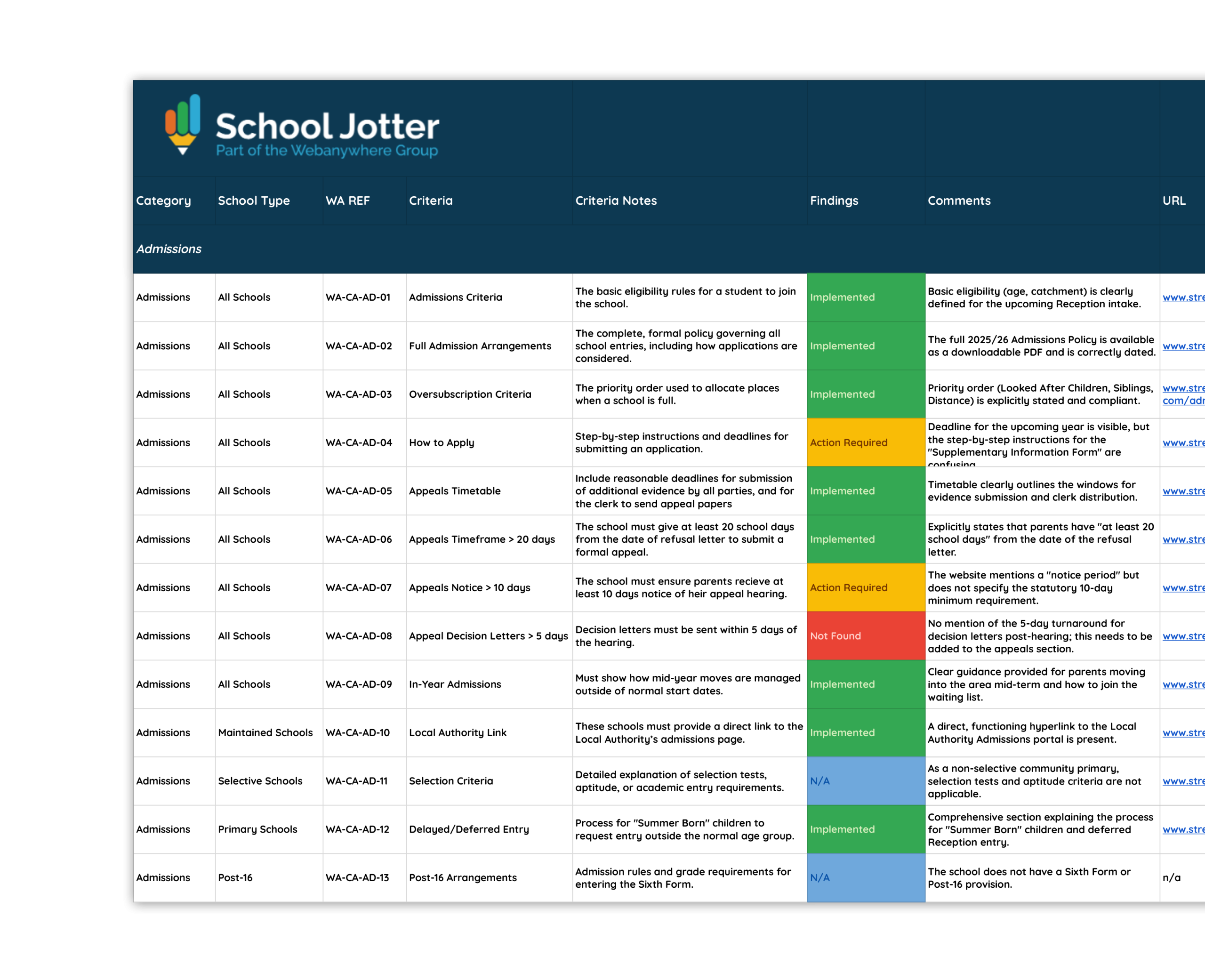
School Website Audit for compliance

For many prospective parents and students, your school website will be the first port of call. Your school’s website will be the very first impression they get of what you offer. It is also very common for the DfE and Ofsted to regularly inspect your website to ensure that it is compliant with various pieces of legislation and policies. It is, therefore, essential that your site is regularly audited.

Let’s discuss this in a bit more depth.

1. Ensures Compliance with DfE & Ofsted Requirements

Both the Department for Education (DfE) and Ofsted have stringent requirements about the information that needs to be included on a school website. For example, your website legally needs to have pages dedicated to certain policies, SEND, and school governance. The problem? These requirements regularly change, and these changes are not always communicated in the best possible way. Plus, with the amount of work you likely need to perform on school administrative tasks, those that are communicated can easily be missed.

Unfortunately, while Ofsted does understand that these requirements can get missed, it will still have an impact on Ofsted reports (or other random inspections), which can result in the school getting rated down in certain areas.

Regular audits from a third-party will ensure that your website can stay up to date with the various requirements.

2. Identifies Hidden Gaps You Didn’t Know Existed

Many schools, incorrectly, assume that their website works fine. They believe if they don’t updated (which is a problem in itself), nothing can break on the website. This couldn’t be further from the truth.

A website that isn’t regularly updated can have:

  • Missing documents e.g. if there are links to school timetables, policies, etc.
  • Broken links.
  • Outdated information

A lot of the time schools don’t even know that these issues exist. They assume everything is OK. There are some schools that run automated tools to try and check for these errors. The problem is that these tools don’t catch everything and, in some cases, they miss the context of certain information and can highlight errors when there aren’t any.

Human auditors, if they are experienced, will catch issues no other person or piece of software will.

3. Saves Time for Busy School Staff

Carrying out a proper school website audit takes a huge amount of time. Time that schools often cannot spare. Most schools cannot have their administrative staff spending hours cross-referencing documents to ensure their website is legally compliant. Not to mention that some of the guidance documents are a bit vague and can often have staff members guessing what they should do.

Putting it in the hands of an experienced school website will ensure that everything is done ‘by the books’. There will be no guesswork. The information on the website will be accurate as per the letter of the law, and the website will just work.

4. Improves Website Structure & Usability

The job of an auditor is not only do ensure that a website is compliant, but it is usable.

Many school websites are exceedingly tough to browse. The information may be there, but it may be hidden under layers of different links, and can be tricky to find. This isn’t good for inspectors or parents. The information needs to visible.

An auditor can give guidance on providing a better structure for the content of a website. Follow their advice, and your website offers much more clarity for those visiting.

5. Gives You a Clear Action Plan (Not Just Problems)

An auditor doesn’t just provide your school with a list of problems on your school’s website, they provide you with much-needed advice on how those problems can be solved. A good auditor will provide a checklist of problems, and solutions for fixing them.

A good auditor will also highlight which fixes should be a priority on your website, and which ones can be left a little (although, all problems should be fixed as soon as practical). A good auditor will also provide step-by-step improvements for the school’s website, making it easier to keep everything up to date, even if you have little experience with the changes that need to be made.

When Should You Get a School Website Audit?

At the absolute minimum, a website should be reviewed every year. In most cases, legal requirements will have changed during that period and data needs to be updated. In other cases, information about the school will also need to be updated in that period. So, an audit should happen. It ensures no problems are missed before you head into the new school year.

We also highly recommend that a website is audited before an Ofsted inspection. This will ensure that when Ofsted browses your website, and they will, they won’t find any issues.

If you have your website redesigned, have an audit carried out. This will ensure information is up-to-date, and any dead links are handled.

Finally, if you know DfE or Ofsted requirements are changing, get the website fixed.

What Makes a Good School Website Audit?

A school website should be human-led. No automation. Automation rarely catches all issues. In fact, in many cases, automation will throw up false positives. This means you may be spending time making corrections that don’t need to be made.

The auditor should always consider the latest DfE and Ofsted guidance, to ensure that the website meets requirements. So, an audit should only ever be carried out by an auditor experienced with schools in the UK.

Finally, an audit will not just highlight issues, but give clear, actionable recommendations about how they should be fixed.

5 Benefits of A School Website Audit

A school website audit will ensure that the site is compliant with the law, will save school staff time updating things, and ensure that everything is clear for both inspectors and parents. Having a proper audit carried out will remove uncertainty about whether your school website is fit for purpose.

Get in touch today to find out more about our audits for schools websites today.

Digital School Profiles: What They Mean For Parents & Schools

Published: October 20, 2025

school report card

Back in March 2025, Bridget Phillipson announced the introduction of ‘digital school profiles’. Something the government pledged would be a step towards making schools much more accountable for their actions. The aim of digital school profiles is to improve transparency in schools. Partly, to force schools to kick themselves up a notch in performance and, partly, to allow parents more information about what schools are available to their children and how those schools are performing.

Digital school profiles are nothing new, with Ofsted offering profiles online for schools, and various ‘ranking’ websites providing more information. However, the whole idea of the system devised by the government is to make the system much more centralised and, hopefully, better. Let’s see how it’ll work.

What are Digital School Profiles?

At the moment, it is not yet known what digital school profiles will entail. However, the basic proposal suggests that digital school profiles will aim to collate the information that, so far, has been spread across multiple resources. So, exam results, attendance, Ofsted reports, and any other important facts that a person would need to know about the school.

The idea is that parents won’t need to hop around multiple sites to find information about schools. They’ll find proper, up-to-date, information on a single website. The information should also be much clearer. This sort of accessibility will be fantastic as it will give parents useful information about how schools are performing.

Why is the Government Making the Change?

According to Bridget Phillipson, the purpose of digital school profiles is to offer a ‘significantly strengthened school accountability system’ coupled with raising ‘the bar on what we expect from schools’. Much of the idea of digital school profiles has been born from the amount of pressure the government has been facing to improve the state of schools in the country.

The government wants to make it easier to see which schools are performing well, and which ones leave a lot to be desired. By offering colour-coded judgements across multiple areas, schools (and parents) can easily see where a school is strong and where it is weak. This will, hopefully, signal a move away from single headline grades which can make determining where issues lie tough.

What This Means for Parents?

The main benefit for parents is that it becomes a whole lot easier to compare schools. Information will be much easier to read, and compare. This can be useful for parents who are fortunate enough to live in an area where their children can attend two different schools.

As we said, the data will also be clearer. There’ll be no bouncing between websites, trying to analyse the reams of information available to come up with a comparison. The comparison will be very easy to decipher.

It should also be much easier for parents to determine what the strengths and weaknesses of each school is. No need to read though loads of complicated Ofsted reports (although, they’ll still be available).

What This Means for Schools

Schools will have much better visibility of their performance data. This can be good or bad, depending on the school. Schools will just know information about how they are performing will be much, much easier to access.

Schools will have to work even harder to ensure that their websites are up to date and Ofsted-compliant. With the introduction of digital profiles, there is a much greater focus on ensuring that schools share the right information. All data on the school’s website needs to be clear and match any official profile.

How School Jotter Can Help

Here at School Jotter, we know just how much schools can have on their plate. While digital profiles are good news for education, it can be tough to stay compliant with the new rules. This is especially true in the early days. This is why School Jotter wants to help.

We can offer Ofsted-complaint website management, ensuring your school stays on top of ever-changing digital profile rules. We can ensure that all key performance information is displayed in parent-friendly formats. We can also ensure that parental engagement with your school’s website is far higher too.

Our team can help keep the link between your school website and Department for Education profile seamless, ensuring that parents can quickly find all the information they need.

Digital School Profiles Explained

New digital school profiles benefit parents in allowing them to have far greater clarity about how schools are performing, ensuring fairer comparisons between schools. Schools will have all their data front and centre, giving them far greater accountability. Hopefully allowing them to show off their achievements, or drive themselves to improve.

Digital school profiles are new, and schools need to stay on top of things to ensure they stay compliant with new rules. This means having a quality website designed. Get your website Ofsted-ready with School Jotter, ensuring that you spend less time keeping your school’s website complaint, and more time focusing on improving education in your school.

Mandatory School Website Information

Category: Compliance

Published: November 7, 2024

School Website Compliance Information

Schools have a duty to share critical information with their communities. From admission arrangements to exam results, every maintained school in England must make certain details available online. But beyond ticking a box, why does this matter?

In essence, publishing information builds trust. It’s not just about legal compliance; it’s about empowering parents, carers, and students. When schools are transparent, communities gain insight into policies, values, and the resources available to students. Here’s a breakdown of what’s required and why it’s important.

The Essentials of School Information Regulations

School information requirements stem from the School Information (England) Regulations 2008, updated in 2012 and 2016, as well as other key pieces of legislation such as the Equality Act 2010 and the Children and Families Act 2014. Schools without websites must still make this information accessible, linking to it through alternative websites and offering paper copies free of charge upon request.

Admission Arrangements

Foundation and voluntary-aided schools need to lay out their admission policies by 15 March each year for September’s normal entry. This should clarify how applications are considered, the number of places available (PAN), and any selection criteria. When applications exceed available spaces, schools should be transparent about how they allocate places. For sixth-form admissions, the process for external applicants should also be detailed.

For mid-year admissions, guidance must be in place by 31 August. Schools must either handle these applications or link to the local authority’s in-year co-ordination scheme, depending on who manages the process.

Behaviour Policy

A school’s behaviour policy defines expectations and the boundaries of acceptable conduct, a necessary compass for any learning environment. Schools must publish this policy under section 89 of the Education and Inspections Act 2006. By making this accessible, schools set clear expectations for students, staff, and parents alike, creating a framework that supports a positive, safe environment.

Careers Guidance for Secondary Schools

For students in years 7 to 13, secondary schools must publish information on their careers programme. This includes contact details of the careers lead, programme highlights, and a way to measure its impact. Under the Education Act 1997, schools also need a statement outlining the access they provide to technical education and apprenticeship providers.

Charging and Remissions Policies

Schools must make clear when and why they charge for activities and any instances where charges may be waived. This is outlined in sections 449-462 of the Education Act 1996, and transparency here is essential for equal access to school activities, regardless of financial circumstances.

Complaints Policy

A transparent complaints policy is vital for any institution that values community trust. Schools are required to publish this under section 29 of the Education Act 2002, as well as details on complaints about SEN support. This allows parents and carers a structured path to voice concerns and seek resolutions.

Contact Details, Curriculum, and Accessibility Plans

Contact details, including a point person for queries, make schools accessible to parents and carers. Additionally, schools should publish curriculum details by subject, year, and stage, as well as any accessibility plans for students with disabilities. These plans are particularly meaningful, ensuring equal access to education and meeting obligations under the Equality Act 2010.

Financial Transparency

Schools with staff earning over £100,000 annually must publish salary bands in increments of £10,000, along with a link to the financial benchmarking service. By revealing financial information, schools help assure taxpayers and parents of responsible spending.

Governance and Ofsted Reports

Governance structures and Ofsted reports provide insight into school leadership and performance. Publishing this information offers parents a closer look at the school’s operation, accountability, and standards.

Gender Pay Gap and Equality Reporting

For schools with 250 or more employees, the Equality Act 2010 mandates annual gender pay gap reporting. Publishing this information, and possibly an action plan, helps schools address equality and pay disparity transparently.

Public Sector Equality Duty

Schools are expected to show how they meet the public sector equality duty, including setting and sharing equality objectives every four years. This demonstrates commitment to equality and inclusivity across the school community.

PE and Sport Premium

For schools receiving PE and sport premium funding, publishing spending and impact details ensures that funds are used to benefit students. Schools must also report on Year 6 students’ swimming proficiency and their ability to perform basic water safety.

Test and Exam Results

Schools must link to performance measures on the government’s compare school and college performance service. Primary and secondary schools must publish key performance metrics like the Progress 8 score, GCSE results, and post-key stage destinations. This is especially vital now, as measures like progress scores may be temporarily adjusted due to pandemic disruptions.

The Bigger Picture: Why Information Matters

Publishing information is not a bureaucratic chore; it’s about making schools accountable to the families they serve. Parents and carers get a clear view of the school’s values, priorities, and resources, making them partners in their child’s education. Schools become more than institutions—they become open, accessible, and responsive parts of the community.

For schools, transparency builds credibility. For families, it fosters understanding and trust. Information sharing is a powerful tool, reinforcing the connection between schools and the people they serve.

New School Report Card System by 2025

Category: Compliance

Published: September 3, 2024

Ofsted Inspection Changes

Imagine, if you will, the moment when a parent first glimpses an Ofsted report. For years, that report has been distilled into a single word—“Outstanding,” “Good,” “Requires Improvement,” “Inadequate.” This word would hold the power to shape perceptions, to define the narrative of a school’s effectiveness, and to chart the course of children’s futures. But what if that single word, in all its simplicity, was hiding more than it revealed?

The new School Report Card system is about peeling back that layer of simplicity and exposing the complex, nuanced reality beneath. It’s about moving beyond a world where schools are judged by a single headline, to a new paradigm where performance is dissected, understood, and acted upon with the precision of a surgeon’s scalpel.

In this new system, schools are no longer reduced to a solitary adjective. Instead, they are evaluated across a spectrum of categories—each one illuminating a different facet of the school’s performance. Think of it as the difference between a single brushstroke and a full painting. The categories—Quality of Education, Behaviour and Attitudes, Personal Development, and Leadership & Management—are not just labels; they are lenses through which the true character of a school is brought into focus.

But what’s truly revolutionary about this shift is not just the granularity of the assessment. It’s the transparency. For too long, parents have been left to interpret those single-word judgments like oracles deciphering ancient runes. Now, they will have a map—a detailed, multifaceted guide to understanding how a school performs across the board. This is not just information; it’s empowerment. Parents can now see where a school excels and where it needs to improve, and they can do so in a way that is clear, precise, and actionable.

Yet, the change goes deeper still. The School Report Card system isn’t just about identifying problems; it’s about solving them. Enter the Regional Improvement Teams, the cavalry riding in not to chastise but to support. Their mission is to work with schools, not against them, providing the expertise and resources needed to turn weaknesses into strengths. This approach is more than just kinder—it’s smarter. It recognises that improvement is not a product of pressure alone but of support, guidance, and collaboration.

The introduction of this system is not a sudden upheaval but a carefully orchestrated transformation. It begins now, with more detailed inspection reports, gradually building towards the full implementation of the School Report Cards in 2025. It’s a phased approach that ensures schools and parents alike can adapt, learn, and grow with the system.

In the end, this shift is about rethinking what it means to assess a school’s worth. It’s a recognition that the old system, with its reductive simplicity, was never enough. The School Report Card system offers a richer, more complex portrait—one that captures not just where a school stands today, but where it could go tomorrow.